
In engineering circles, the climate conversation is usually framed around one dominant assumption: a steadily warming world. We talk about heatwave resilience, cooling demand, overheating in buildings, and the long-term consequences of rising sea levels. Those risks are real. But new modelling around the Atlantic Meridional Overturning Circulation (AMOC) points to a scenario that appears to defy that logic entirely.
For the UK, and especially for Scotland, climate change may not simply mean warming. It could also mean the return of brutal cold.
Recent research suggests that a collapse of the AMOC is no longer just a distant, low-probability thought experiment. It is increasingly being treated as a credible mid-century risk. For a country whose infrastructure, energy system, ports, and maritime economy are deeply tied to the North Atlantic, that possibility should command serious engineering attention.
What the latest modelling is telling us
The AMOC, which includes the Gulf Stream system, acts as one of the planet’s great heat conveyors, transporting warm water northwards into the North Atlantic. It plays a central role in moderating the climate of the British Isles and much of northwestern Europe.
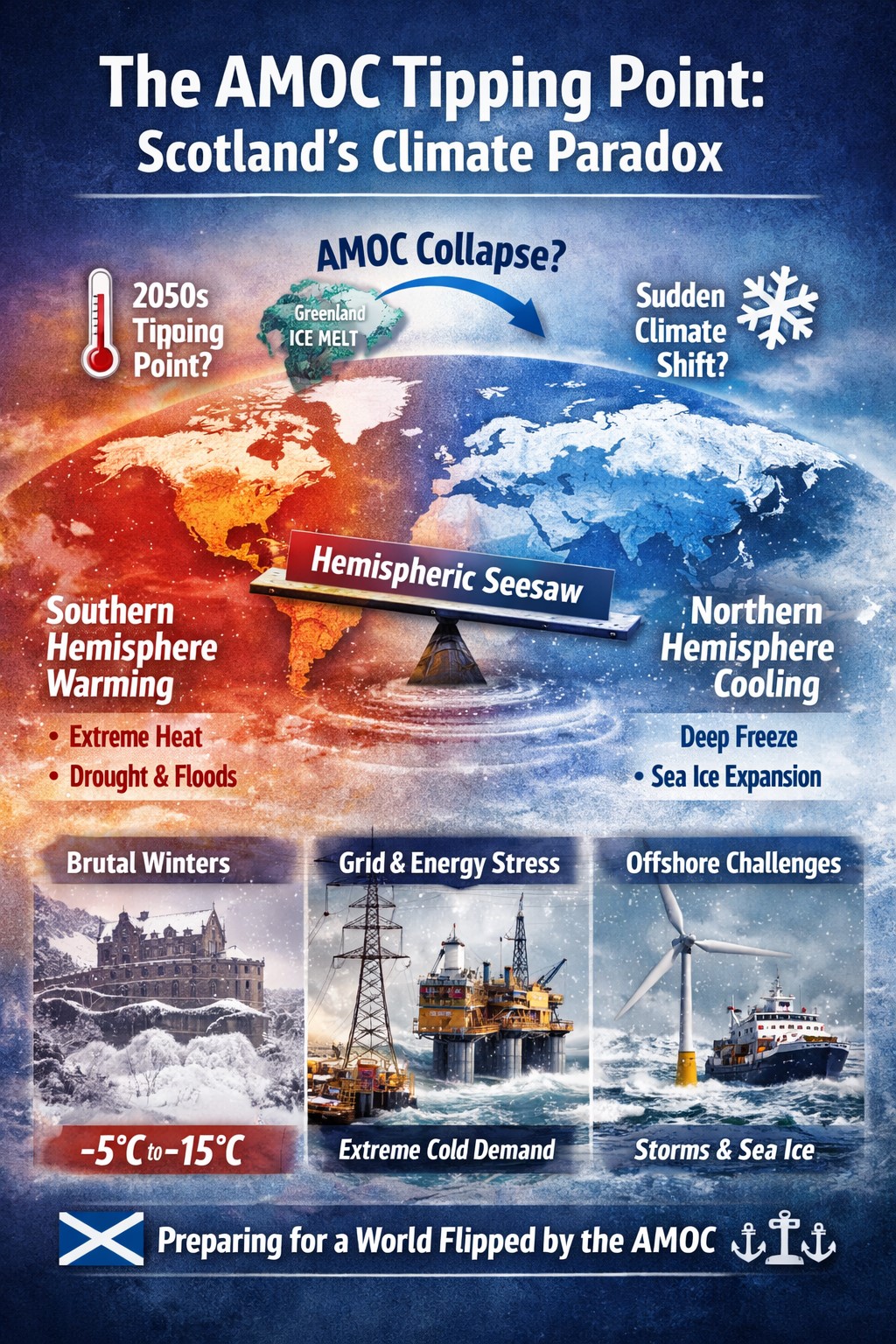
For years, most climate discussion assumed that this circulation would weaken gradually rather than fail abruptly. But more recent work, drawing on concepts such as Critical Slowing Down (CSD) and the growing freshwater input from Greenland ice melt, suggests the system may be approaching a non-linear tipping point.
That changes the conversation entirely.
Instead of a slow decline that can be absorbed over generations, the concern is now a more abrupt transition. Some analyses place the highest probability of collapse between 2050 and 2095, with the late 2050s emerging as a particularly important period of concern.
The paradox Scotland may face
If the AMOC were to collapse, it could trigger what is often described as the Hemispheric Seesaw. In simple terms, heat distribution between hemispheres would be disrupted. While parts of the Southern Hemisphere could warm further, the North Atlantic region would lose one of its major sources of moderating heat.
For Scotland, that could mean something deeply counterintuitive: a sharp regional cooling in the middle of global climate change.
This is not merely a matter of “slightly colder winters.” Some models indicate winter temperature drops of 5°C to 15°C across affected regions. That implies a far more hostile operating environment: harsher winters, greater weather volatility, possible sea-ice expansion into parts of the North Sea, and a complete redefinition of the seasonal baseline on which much of our infrastructure planning still depends.
Why this matters for engineers now
This is where the issue moves from climate theory to engineering risk.
Much of our infrastructure strategy is still based on a relatively linear assumption: decarbonise while adapting to gradual warming. But an AMOC collapse would overturn that framework. It would mean designing not only for hotter summers and flooding, but also for the possibility of sudden, sustained, sub-Arctic winter conditions in a country not built for them.
That raises immediate questions.
Can our power networks withstand dramatically higher winter heating demand?
Is our housing stock remotely prepared for prolonged deep cold?
How resilient is a heat-pump-led transition if temperatures remain far below freezing for extended periods?
Are today’s resilience models testing the grid for the kind of sustained winter peak loads this scenario would create?
For Scotland’s engineers, the challenge is no longer just efficiency in a warming climate. It is adaptability in a destabilised one.
The offshore challenge Scotland cannot ignore
Scotland’s economy and engineering identity are inseparable from the sea. From offshore wind and tidal energy to ports, shipping, marine services, and decommissioning, our future is tied to the North Atlantic.
That is precisely why AMOC risk matters so much here.
Without the regulating influence of the AMOC, the North Atlantic is expected to become harsher, stormier, and less predictable. That has major implications for offshore operations. Wind farms, tidal systems, subsea infrastructure, and marine construction could all face a more severe metocean environment than current planning assumptions allow for.
Extreme wave loading, more frequent storm events, harsher winter operating windows, and even ice-related hazards may all become part of the design problem. The very offshore environment Scotland is depending on to drive its net-zero transition could become significantly more difficult, more dangerous, and more expensive to engineer within.
A global disruption with local consequences
The risks do not end at our coastline.
An AMOC collapse would not just cool the North Atlantic. It would also disrupt atmospheric circulation and shift the tropical rain belt southward, with major consequences for agriculture and trade. Severe droughts in some regions, flash floods in others, and widespread harvest disruption would reverberate through global supply chains.
For Scotland and the wider UK, that means ports, logistics systems, food resilience planning, and industrial supply networks would all come under pressure. Engineering resilience would need to extend well beyond domestic assets to include the flexibility of the systems that connect us to the wider world.
Deep-water ports, distribution networks, storage systems, and agricultural technologies would all need to cope with a far less stable global trading environment.
Bottom line
The AMOC is not just an oceanographic curiosity. It is a strategic engineering risk.
If the science continues to point in this direction, then Scotland’s engineering community cannot afford to plan for only one climate future. We must prepare for a world in which global warming does not eliminate regional cold shocks, but coexists with them.
That means designing infrastructure, grids, housing, offshore assets, and supply systems that are efficient enough to support net zero, but resilient enough to withstand the cold, volatility, and disruption of a weakened or broken North Atlantic circulation.
The warning signs may still be unfolding in the data. But for engineers, waiting for certainty is rarely a strategy. Our responsibility is to plan for plausible high-impact risk before it becomes reality.
The ocean may be giving us an early warning.
The question is whether we are willing to engineer accordingly.
By IES Fellow Amro Heikal